
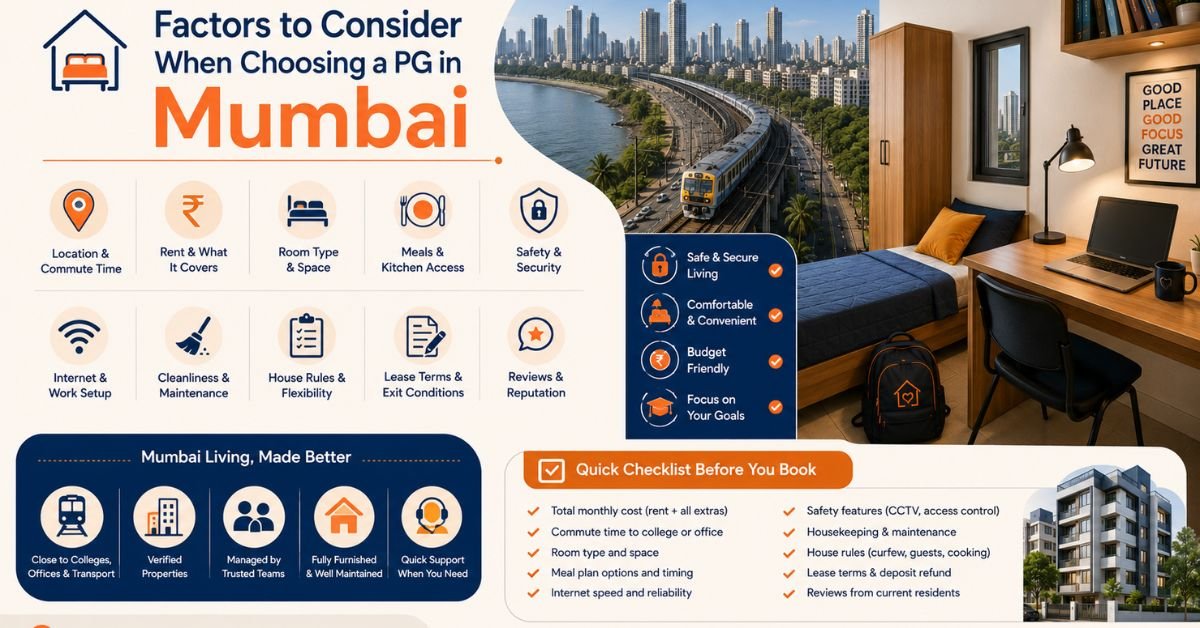
Factors to Consider When Choosing a PG in Mumbai
Moving to Mumbai is a big deal. The city runs fast, costs a lot, and gives you very little margin for error, especially when it comes to finding a place to live. A paying guest (PG) accommodation is often the first stop for students and working professionals who are new to the city. But not every PG is worth your money or your peace of mind.
Here is what you need to think through before you sign anything or pay a deposit.
Why Choosing the Right PG in Mumbai Takes More Than a Quick Search
Mumbai is one of India’s most densely populated cities. According to the Census of India (2011, Office of the Registrar General & Census Commissioner), the Mumbai Metropolitan Region holds over 20 million residents. Housing demand stays intense year-round. That means listings move fast, and decisions made in a hurry often come with regrets.
The PG market in Mumbai ranges from bare-minimum rooms to fully furnished co-living spaces with meals, laundry, and housekeeping included. The gap between those two ends is wide. Knowing what matters to you before you start searching saves time and prevents costly mistakes.
Let’s break it down.
1. Location and Commute Time
This is the first thing to sort out. Mumbai’s traffic and train network are both legendary and not always for good reasons.
A PG that looks affordable on paper can turn expensive once you factor in daily commute costs and the hours you spend traveling. The Mumbai Suburban Railway, operated by Central Railway and Western Railway (Indian Railways, Ministry of Railways), covers most of the city, but peak-hour travel on packed trains is genuinely exhausting.
Pick a PG that sits within walking distance or a short auto ride from your college or office. Areas like Navi Mumbai, Vashi, Ghansoli, and Koparkhairane offer good connectivity along the Harbour Line and Trans-Harbour Line, making them practical choices for students and professionals who want to avoid the chaos of South Mumbai or the Western suburbs.
Ask yourself: How long will I spend commuting each day? If the answer is more than 45 minutes one way, look for something closer.
2. Rent and What It Actually Covers
Monthly rent is only part of the story. Here is what catches many first-time renters off guard.
Many PGs advertise a base rent but charge separately for the following:
- Electricity (sometimes billed at commercial rates, not residential)
- Water and maintenance fees
- Meals (especially if it is a self-service PG)
- Laundry
- Parking or two-wheeler storage
Before finalizing anything, ask for a full cost breakdown in writing. Add everything up and compare that total, not just the base rent, across different PGs.
Some co-living providers include all amenities in a single monthly figure. That model is easier to budget around, especially if you are new to the city and do not want to track multiple bills.
3. Room Type and Space
Think about how you plan to use your room. If you work from home even partially, a single-occupancy room is worth the extra cost. Shared rooms with two or three beds per unit bring the rent down but come with trade-offs: noise, different schedules, and less personal space.
Check the room size before committing. Some PG rooms labelled as “triple sharing” in Mumbai pack three people into spaces that would be uncomfortable for one. Visit in person if you can. Photos on listing platforms are almost always taken with wide-angle lenses that make rooms look larger than they are.
Also check:
- Ventilation and natural light
- Number of power outlets
- Storage space (shelves, cupboards, lockers)
- Whether the mattress, pillow, and bedding are included
4. Meals and Kitchen Access
Not every PG offers food. Decide early whether you want meals included or prefer to cook for yourself.
If you opt for a PG with meals, ask about the menu variety and timing. Some PGs serve two meals a day (breakfast and dinner); others serve three. If meal timing does not match your schedule, you will end up spending extra on food outside anyway.
For self-service PGs, check whether there is a shared kitchen with a working stove, refrigerator, and adequate counter space. Also confirm the rules around cooking. Some PGs restrict cooking in the room entirely.
5. Safety and Security
This one is non-negotiable. Here is why.
Mumbai is a relatively safe city, but safety standards across PGs vary a lot. When you visit a property, look for:
- CCTV cameras in common areas and entry points
- A secure main gate with controlled access
- An on-site caretaker or warden (at least during specified hours)
- Well-lit corridors and staircases
For women specifically, check whether the PG is women-only or mixed and what the entry and exit protocols are. Several localities in Navi Mumbai and the western suburbs have well-established women’s PGs with stricter access controls.
Ask about the visitor policy too. Some PGs do not allow guests past the lobby. Others are more relaxed. Know what you are getting into before you move in.
6. Internet and Work-from-Home Setup
A reliable internet connection is no longer a luxury. It is part of the basic package for anyone who works, studies, or takes online classes.
Ask specifically:
- What is the internet speed (in Mbps)?
- Is it fiber broadband or a shared mobile hotspot?
- Is there a data cap?
- What happens during outages, and how quickly are they resolved?
Slow or unreliable Wi-Fi is one of the top complaints from PG residents across Mumbai. If the PG cannot answer these questions clearly, treat that as a warning sign.
7. Cleanliness and Maintenance Standards
Visit the property on a regular day, not after the landlord has just had it cleaned for a showing. Check the bathrooms, kitchen, and common areas. Look at the condition of the walls, windows, and fixtures.
Ask how often housekeeping is done. A good PG cleans common areas daily and handles room cleaning at least a few times a week. Find out who to contact when something breaks. Response time for maintenance issues like plumbing or electrical problems tells you a lot about how a property is managed.
8. House Rules and Flexibility
Every PG has rules. The question is whether those rules work for your lifestyle.
Common rules to ask about:
- Gate closing time
- Guest policy
- Noise restrictions
- Rules around cooking or appliances like irons and kettles
- Pet policy (rare, but worth confirming if relevant)
Some PGs operate with very rigid curfews. If you work late shifts, have evening classes, or have an active social life, a 10 PM curfew will cause friction quickly. Confirm the rules upfront and make sure they match how you actually live.
9. Lease Terms and Exit Conditions
Read the agreement before you sign it. This sounds obvious, but many people skip it.
Specific things to check:
- What is the minimum lock-in period?
- How much advance notice do you need to give before vacating?
- What are the conditions for the security deposit refund?
- Are there penalties for early exit?
Some PGs charge two to three months’ rent as a security deposit. Knowing the refund conditions before you pay protects you later.
10. Reviews and Reputation
Ask current residents what they actually think. Online reviews on Google Maps or housing platforms give you a starting point, but a five-minute conversation with someone who lives there is more revealing.
Find out whether the management responds to complaints. Check whether there are recurring issues in reviews (water supply problems, billing disputes, pest infestations). A consistent pattern of negative feedback usually reflects something real.
Properties like those managed by CozyStays in Navi Mumbai, which has operated since 2013, build their reputation through consistent management standards, on-ground maintenance teams, and clear pricing. That track record matters when you are choosing where to live for months at a time.
PG in Mumbai vs. Navi Mumbai: What Is the Difference?
Mumbai proper (the island city and the western suburbs) tends to have higher rents and more congestion. Navi Mumbai, planned and developed by CIDCO (City and Industrial Development Corporation of Maharashtra), offers better road layouts, newer infrastructure, and generally lower PG rents for comparable amenities.
For students attending institutions near Vashi, Kharghar, or Nerul, or professionals working in Airoli, Ghansoli, or Mahape, a PG in Navi Mumbai often makes more practical sense than commuting from the city.
CozyStays, for instance, focuses its properties in Navi Mumbai, with options in Ghansoli, Koparkhairane, and areas near major educational institutions like NMIMS. That kind of location-specific focus means the properties are chosen with commute patterns in mind.
Quick Checklist Before You Book a PG in Mumbai
Use this before making your final decision:
- Total monthly cost (rent plus all extras)
- Commute time to college or office
- Room type and space (single, double, or triple sharing)
- Meal plan options and timing
- Internet speed and reliability
- Safety features (CCTV, access control, caretaker)
- Housekeeping and maintenance response time
- House rules (curfew, guests, cooking)
- Lease terms and deposit refund conditions
- Reviews from current or former residents
Frequently Asked Questions About PG in Mumbai
What is the average monthly rent for a PG in Mumbai?
Rent varies widely depending on the area and room type. In Navi Mumbai, shared PG rooms typically start around Rs 7,000 to Rs 10,000 per month, while single-occupancy rooms can range from Rs 12,000 to Rs 20,000 or more. Prices in central Mumbai and the Western suburbs tend to run higher for comparable spaces.
Is food included in PG rent in Mumbai?
It depends on the PG. Some properties include two or three meals a day in the monthly rent. Others operate on a self-service model where you cook your own food or pay for meals separately. Always confirm this before booking so there are no surprises on your first bill.
What documents do I need to rent a PG in Mumbai?
Most PG owners ask for a government-issued photo ID (Aadhaar card, passport, or driver’s license), address proof, and sometimes a passport-size photograph. If you are a student, a college ID or admission letter may also be requested. Keep copies ready to speed up the process.
How do I check if a PG in Mumbai is safe?
Visit the property in person during the day and ideally in the evening. Check for working CCTV cameras, a secure entry gate, and adequate lighting. For women, ask specifically about visitor policies and whether the building has a dedicated warden. Reading recent Google reviews also gives you a reliable picture of day-to-day safety standards.
What is the difference between a PG and a co-living space in Mumbai?
A traditional PG usually offers a basic furnished room, sometimes with meals. Co-living spaces tend to include more shared amenities like common lounges, faster internet, regular housekeeping, and flexible lease terms. Co-living options, like those at CozyStays, are often better suited to working professionals who want a more managed living environment without committing to a full flat rental.