
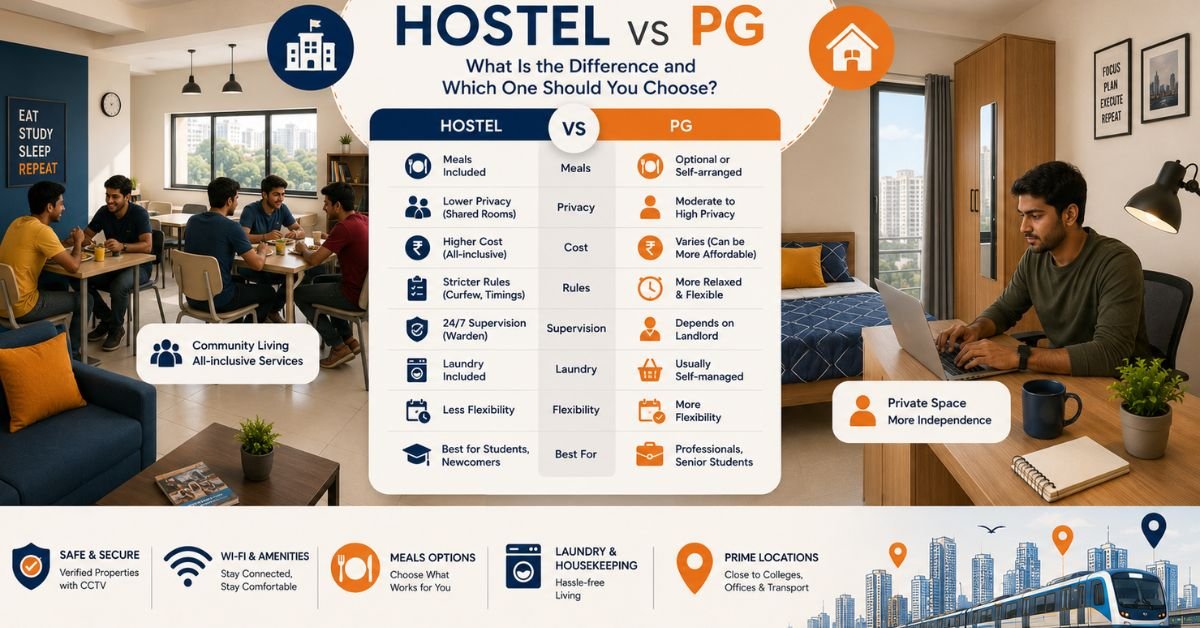
Hostel vs PG: What Is the Difference and Which One Should You Choose?
You just got admission to a college in Navi Mumbai, or maybe you landed your first job there. Either way, you need a place to stay. Two options pop up almost immediately: a hostel or a paying guest (PG) accommodation. And if you have never stayed away from home before, the two sound almost the same.
They are not. The difference between a hostel and a PG affects your daily routine, your monthly budget, your privacy, and even how quickly you settle into a new city. Let’s break it down so you can make the right call.
What Is a Hostel?
A hostel is a shared residential space that comes with a full set of services built in. Think of it as an all-inclusive package for students or working professionals who want zero hassle.
When you stay in a hostel, you typically get:
- A bed in a shared or private room
- Three meals a day (breakfast, lunch, and dinner)
- Housekeeping and laundry services
- 24/7 security and warden supervision
- Common areas like study rooms, TV lounges, or recreation spaces
Hostels run on a structured schedule. Meals happen at fixed times. There may be a curfew, especially in student hostels. The management keeps a close watch on who enters and exits the building.
This structure suits people who want everything taken care of, particularly first-year students who are new to independent living.
What Is a PG (Paying Guest Accommodation)?
A PG, short for paying guest, is a room you rent inside someone’s home or a purpose-built residential property. You pay rent monthly and live there as a tenant, not as a guest in a managed facility.
PG accommodations come in different shapes. Some include meals and Wi-Fi. Others are self-service, meaning you cook your own food, do your own laundry, and manage your own schedule. The level of service depends entirely on what you and the landlord agree on.
Here is what a standard PG typically includes:
- A furnished or semi-furnished room (single, double, or triple sharing)
- Basic amenities like a bed, wardrobe, and a fan or AC
- Optional add-ons: meals, Wi-Fi, water, and electricity (sometimes included in rent, sometimes billed separately)
- More flexibility with timings compared to a hostel
PGs suit people who want independence. You set your own routine, come and go as you please (within any house rules), and generally have more control over your living environment.
Hostel vs PG: A Direct Comparison
Here is a side-by-side look at the differences that matter most when you are choosing:
| Factor | Hostel | PG |
| Meals | Included (usually all three) | Optional or self-arranged |
| Privacy | Low (shared dorms common) | Moderate to high |
| Cost | Slightly higher (all-inclusive) | Varies; can be cheaper if self-service |
| Rules | Stricter (curfew, visitor limits) | More relaxed |
| Supervision | 24/7 warden/management | It depends on the landlord |
| Laundry | Included | Usually self-managed |
| Flexibility | Low | Higher |
| Best for | First-year students, newcomers | Working professionals, senior students |
Key Differences Explained
1. Meals and Daily Living
This is where hostels and PGs split the most clearly. A hostel feeds you. You walk into the dining hall at set times, and your food is ready. No grocery shopping, no cooking, no worrying about what to eat after a long day.
A PG leaves that responsibility to you unless you specifically choose one that includes meals. Self-service PGs often cost less but require more effort on your part.
If you are moving to a new city and have never managed a kitchen, a hostel or a meal-included PG will save you a lot of stress in the first few months.
2. Privacy and Personal Space
Hostels prioritize community over privacy. You share a room with two, four, or even six other people. Common bathrooms and shared lounges are the norm.
PGs, especially single-occupancy ones, give you your own room. You can decorate it, study at 2 AM without bothering anyone, and have your own space to decompress.
For working professionals who need quiet after a long day at the office, a private PG room makes a real difference.
3. Rules and Freedom
Hostels operate more like institutions. There is a warden, a gate log, meal timings, and sometimes a night curfew. Visitors may need prior permission. This structure protects residents but limits freedom.
PGs are more like rentals. You have a landlord, not a warden. Rules exist (no loud music late at night, no unauthorized guests, and so on), but the overall atmosphere is more adult and flexible.
4. Cost Comparison
Hostels cost more per month because they bundle in meals, housekeeping, and services. A hostel in Navi Mumbai might charge between Rs. 8,000 and Rs. 20,000 per month depending on the amenities and occupancy type.
PGs start lower if you go self-service. A shared PG room without meals can run from Rs. 5,000 to Rs. 12,000 per month. Add meals, and the price gets closer to a hostel. Premium single-occupancy PGs with AC and Wi-Fi can go higher than many hostels.
The math differs for every person. Someone who eats out every day may spend more from a cheap self-service PG than they would from a hostel with meals included.
5. Safety and Security
Both hostels and PGs should have basic security measures. Hostels tend to have more formal systems: CCTV, a staffed entry gate, and a warden. PGs vary widely. Some have solid security; others rely on a simple lock and a cooperative neighborhood.
When choosing a PG, always check if the property has CCTV, proper locks, and responsive management. For girls especially, verified and well-managed PG accommodations matter a great deal.
Who Should Choose a Hostel?
A hostel makes sense if you:
- Are a first-year college student new to the city
- Want meals managed without any effort
- Prefer a built-in social life and community
- Need 24/7 supervision for peace of mind (yours or your parents’)
- Are on a tight budget and want all expenses bundled into one bill
Who Should Choose a PG?
A PG makes more sense if you:
- Are a working professional who values privacy
- Already know how to manage daily life independently
- Want the freedom to set your own schedule
- Are looking for longer-term housing with a home-like feel
- Need a quiet space to work from home
What Does the Market Look Like in Navi Mumbai?
Navi Mumbai has seen steady growth in both hostel and PG demand, driven by the presence of universities like NMIMS, Symbiosis, and MIT, plus a large working population in areas like Vashi, Belapur, and Kharghar. According to a 2023 report by NoBroker, demand for PG accommodations in satellite cities of Mumbai rose by over 30% post-pandemic as more students and professionals returned to offices and campuses.
Providers like CozyStays have built their model around offering both options under one roof. CozyStays operates fully furnished PG properties and hostels across Navi Mumbai, with properties ranging from budget-friendly shared rooms to premium single-occupancy setups. Their self-service PG option suits people who prefer independence, while their full-service hostel model works better for those who want meals and laundry handled.
Things to Check Before Booking Either Option
Whether you go for a hostel or a PG, run through this checklist:
- Visit the property in person before paying any deposit
- Read the rental agreement carefully, especially terms around notice period and deposit refund
- Ask about included vs. excluded amenities (Wi-Fi, electricity, water, meals)
- Check the security setup (CCTV, gate access, staff availability)
- Talk to current residents to get an honest picture of day-to-day life
- Confirm the location relative to your college or office; a 20-minute commute matters
A Common Source of Confusion: Hostel Inside a PG Property
Some providers use the terms interchangeably, which makes this more confusing. A building might advertise itself as a “hostel” but operate more like a PG, or vice versa. The real question to ask is, “What services are included, and what rules apply?”
At CozyStays, for example, they explicitly distinguish between their hostel service (with meals and laundry) and their self-service PG option, PG in Navi Mumbai, so residents know exactly what they are signing up for.
Always ask directly, “Does this include meals?” and “What are the rules around guests and curfew?” Those two questions will tell you more than any label.
Frequently Asked Questions
Q1. What is the main difference between a hostel and a PG?
A hostel is a fully managed accommodation with meals, laundry, and round-the-clock supervision built in. A PG is a rented room where you may or may not get meals depending on the arrangement. Hostels are more structured; PGs give you more independence in your daily routine.
Q2. Is a PG cheaper than a hostel?
A self-service PG without meals is usually cheaper than a hostel. But once you add meals and laundry to a PG, the costs often match or exceed hostel rates. Compare the total monthly spend, not just the base rent, before deciding.
Q3. Which is better for girls, a hostel or a PG?
Both can be safe, but hostels generally offer more formal security measures like wardens and CCTV. For girls relocating to a new city for the first time, a managed hostel or a verified PG with good security infrastructure tends to be the safer starting point.
Q4. Can working professionals stay in a hostel?
Yes, many hostels in cities like Navi Mumbai cater to working professionals, not just students. These hostels tend to have more flexible timings and fewer rules than college hostels. Check the property’s target resident profile before booking.
Q5. How do I decide between a hostel and a PG in Navi Mumbai?
Start with your lifestyle. If you want meals handled and a ready-made community, go for a hostel. If you prefer cooking your own food, having a private room, and managing your own time, a PG works better. Factor in your budget, commute distance, and how long you plan to stay.